Blogs
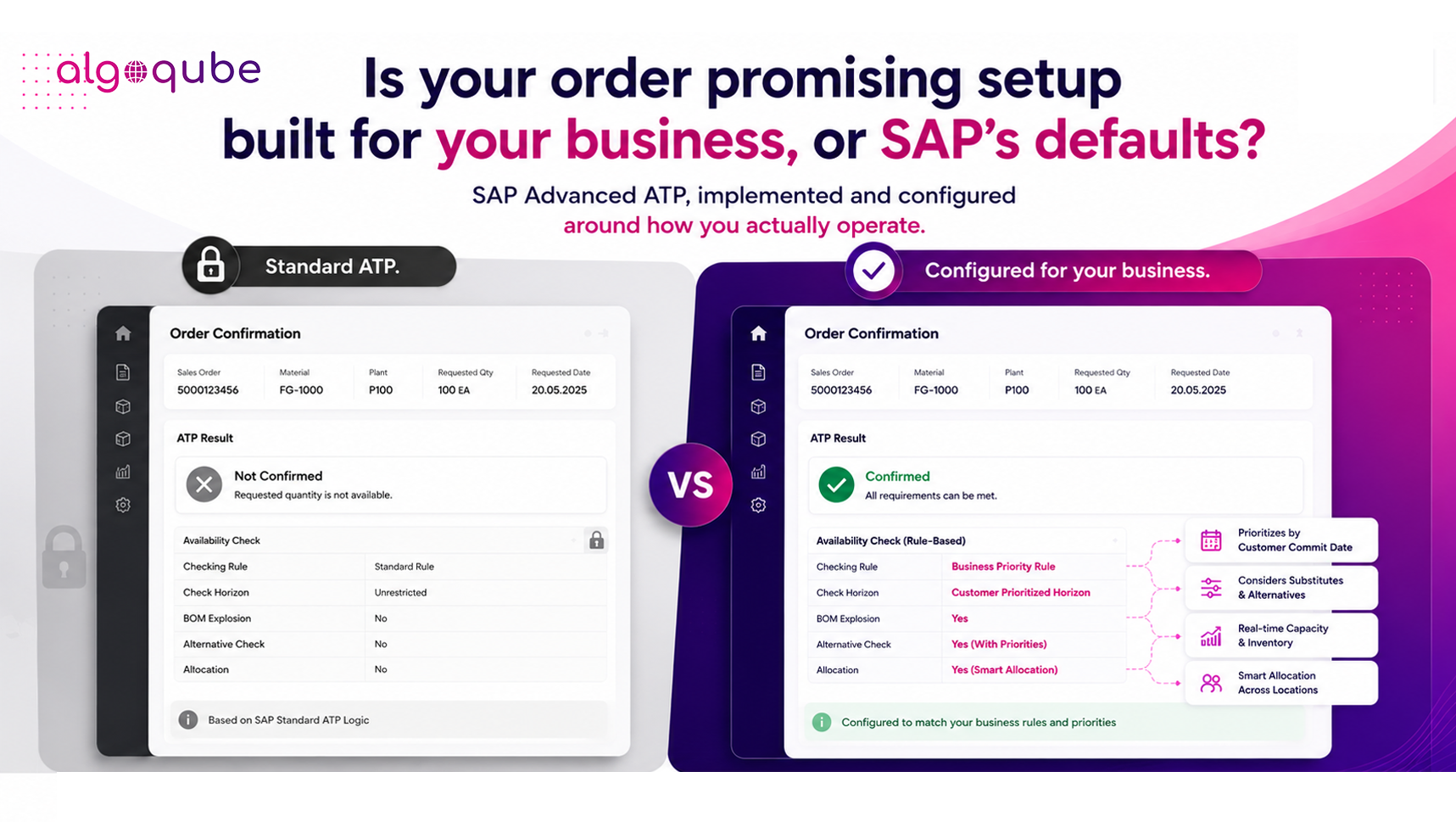
Is Your SAP Advanced ATP Setup Actually Built for Your Business, or Just SAP's Default One?
Is Your SAP Advanced ATP Setup Actually Built for Your Business, or Just SAP's Default One?
Most companies running SAP treat order promising as a background process. Stock gets checked, a date gets confirmed, and the order moves on. Standard ATP handles this adequately for straightforward operations. But for businesses managing complex demand, multiple supply points, or high-value customer relationships, adequately is not enough. SAP Advanced ATP (aATP) is designed for exactly this, enabling rule-based, dynamic order fulfilment rather than simply extending what standard ATP can do. The businesses that get the most out of it are the ones that implement and configure it around how they actually operate.
What Is SAP Advanced ATP (aATP)?
Advanced Available-to-Promise (aATP) is the enhanced order promising functionality in SAP S/4HANA, offering more sophisticated, flexible fulfilment logic than standard ATP. It can apply additional restrictions based on customer interest and priorities, logistical constraints, and alternate fulfilment options, and generate confirmation proposals that protect a business's customer priorities and profitability goals. In short, it gives businesses the tools to decide not just whether an order can be fulfilled, but how order fulfilment can meet stated business objectives.
Why Does It Matter?
Getting order promising right shapes customer experience long before a product ships. A confirmation that turns out to be wrong is what damages trust, not a delay communicated honestly upfront.
- Customer trust: Accurate, rule-based confirmations mean customers are told the truth the first time.
- Revenue protection: aATP prevents over-promising to high-value accounts and under-committing where the business can actually fulfil.
- Operational efficiency: Automated allocation logic reduces manual firefighting, backorder chasing, and last-minute reallocation.
- Supply chain resilience: When supply shifts, aATP re-evaluates and adjusts open orders automatically, rather than leaving the order team to sort it by hand.

The Common Challenges With Standard ATP
Most businesses do not struggle with order promising because it is conceptually hard. They struggle because standard ATP was built to be generic, and their business is not.
- Rigid prioritisation logic: Standard ATP confirms orders on a first-come, first-served basis, with no room to protect strategic accounts when supply runs short.
- One-size-fits-all checks: The same availability logic applies across different products, customers, and order types, even when the business needs different rules for each.
- No dynamic reallocation: When supply changes after an order is confirmed, standard ATP does not automatically re-evaluate. Someone has to do it manually.
- Limited to what is on the shelf: Standard ATP cannot trigger production or source from alternative locations when stock falls short. It confirms what exists, nothing more.
What aATP Actually Enables
aATP introduces advanced decision-making capabilities that enhance inventory allocation, supply protection, and fulfilment optimisation. Here is what that looks like in practice.
- Allocating stock by customer priority: When demand exceeds supply, aATP allows businesses to classify customers into priority tiers, ensuring strategic accounts are always confirmed first, while lower-priority orders are deprioritised or redistributed, without manual intervention.
- Sourcing from alternative locations automatically: aATP's Alternative Based Confirmation allows fulfilment from different or multiple plants, so if stock is unavailable at one location, the system finds it elsewhere according to rules the business defines.
- Re-promising orders when supply changes: aATP's backorder processing re-evaluates all open orders against the current supply picture and adjusts confirmations according to business rules, rather than leaving the order team to manage it manually.
- Triggering production when stock cannot fulfil the order: For make-to-order environments, aATP integrates with production planning to dynamically generate supply elements such as planned orders and purchase requisitions, when existing inventory cannot meet demand.

The Strategic Insight
aATP is not a technical upgrade. It is a set of business rules you have to deliberately design.
SAP's Advanced ATP is built with the flexibility to adapt to specific business requirements, but that flexibility only delivers value when the configuration reflects how a business actually operates. A business selling through both key accounts and long-tail customers needs different allocation logic for each. A business in a volatile-demand category needs protection rules that standard ATP simply cannot provide. The decision to implement aATP should be based on a thorough analysis of business complexity and future growth plans, and the implementation itself needs to be built around how a specific business actually promises to its actual customers, not around SAP's defaults.
This is where most aATP implementations fall short, not because the technology cannot do it, but because the configuration was never tailored to do it.
How Algoqube Helps
At Algoqube, we treat aATP as a business design problem first, and a technical configuration second.
aATP capability assessment: We review your current order promising setup and identify where standard ATP is holding you back.
Custom rule design: We design allocation rules, priority tiers, and confirmation logic that reflect how your business actually sells, not SAP's generic defaults.
Tailored aATP implementation: We implement and configure aATP around your specific business model, customer structure, and supply situation.
Ongoing refinement: As your business changes, we revisit the configuration so it keeps matching how you actually run.

Start with an aATP Capability Review
Improving order promising starts with understanding where your current setup actually stands. A structured review can show where standard logic is quietly costing you, in missed priorities, wrong promises, or rigid rules that do not fit how you sell.
At Algoqube, we help businesses implement and customise SAP Advanced ATP around their own operations, instead of running on default logic built for everyone else. Get in touch to start your aATP capability review.
Take the next step
Ready to start your journey with Algoqube, or need our help?
